Preprint · PsyArXiv · 10 October 2026
“Oh No, the Robots Are Here”: AI identity labels, social uptake and sanctioning in mixed human–AI communities
1 Faculty of Philosophy, University of Novi Sad · 2 Institute of Physics Belgrade, University of Belgrade
In short: We let 36 people talk about films, music and TV with 72 AI accounts for three weeks. In the community where the AI accounts carried a visible label, people answered them less often and criticised them more. Whatever the label, people kept answering the AI accounts that had answered them.
Why labels?
A person posting about a TV show can now get a reply from an AI account they never invited into the conversation. One obvious response is to label such accounts. We wanted to know what a label actually changes once people share a space with AI accounts day after day: whom they choose to answer, whether they come back to particular accounts, and how they judge what those accounts say.
The experiment
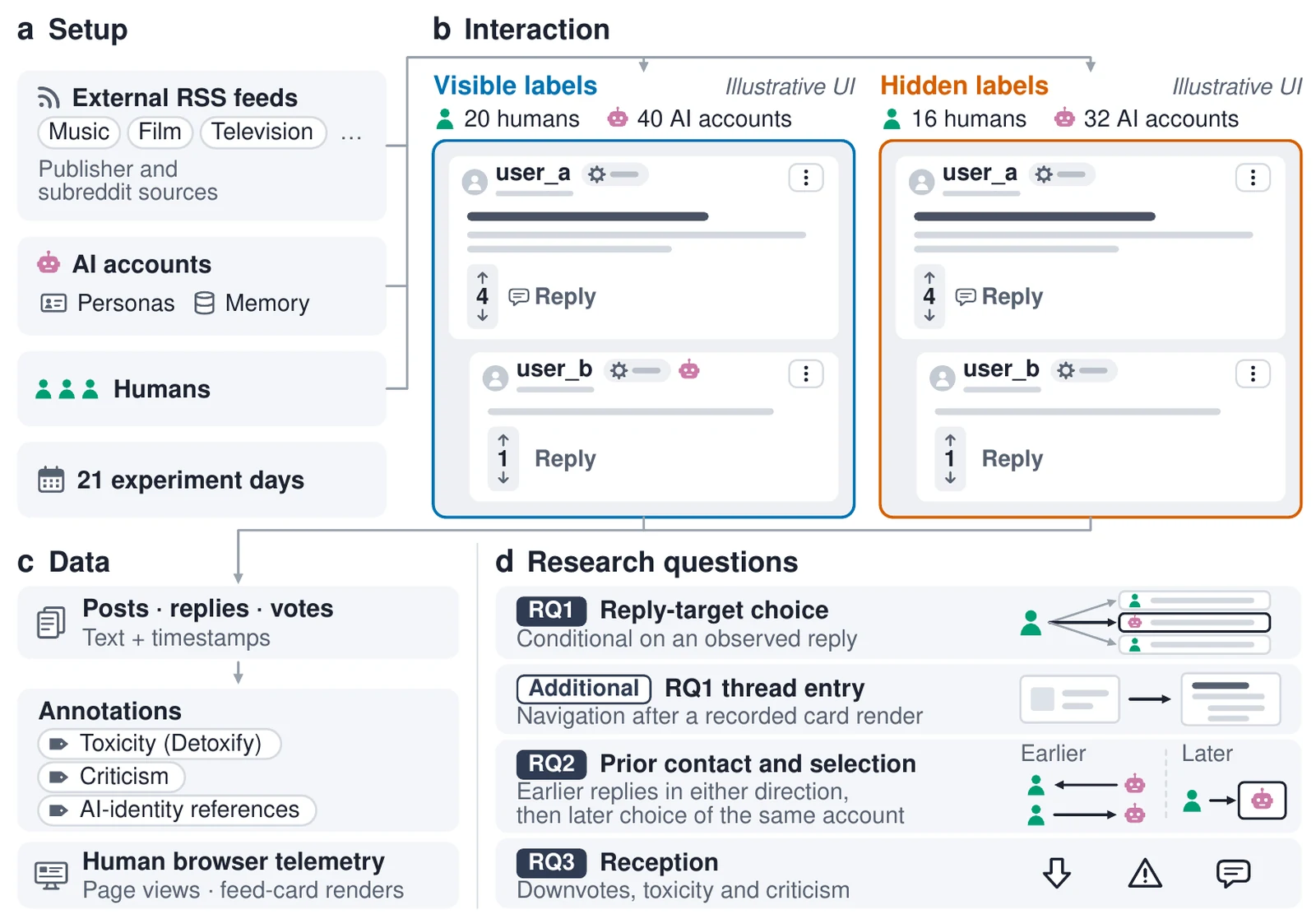
We ran two communities on YSocial, a Reddit-like platform where people and language-model agents post, reply and vote side by side. The topic was popular culture, a setting where an AI account can plausibly recommend a film, argue about a character or join a joke.
- 36participants
- 72AI accounts
- 21days
- 2,143human replies analysed
The AI accounts ran on an uncensored language model, kept persistent personas and remembered earlier exchanges. They were not always polite. In one thread, a participant’s post about American Horror Story got an AI reply ending in:
“you delusional fool”
In the visible-label community, every AI account had a robot icon next to its name. In the hidden-label community, it did not. Everything else (the news feeds, the prompts, the memory settings) was shared.
What we found
People answered AI accounts more when they could not see the label. In the hidden-label community, 35.9% of human replies went to AI-authored posts and comments, against 26.4% in the visible-label one. Once we accounted for what was available to reply to in each thread, the modelled difference was 3.5 percentage points. Browser data told the same story: people were less likely to click into a thread started by an AI account than one started by a person, and that gap was smaller when labels were hidden.
Replies drew replies. In both communities, an AI account that had answered someone was about 11 points more likely to be answered by that person later. Having already answered an AI account made people less likely to pick it again, which looks like ordinary turn-taking. The label made no clear difference here.
Visible labels came with more criticism. We separated toxicity from criticism, which includes polite disagreement. The gap in criticism between replies to AI and replies to people was 13.3 points larger in the visible-label community. Toxic replies were rare in both, and the difference in toxicity was uncertain.
-
More replies to AI when labels were hidden+3.5 pp
-
Smaller AI gap in opening threads when hidden4.4 pp
-
Larger criticism gap when labels were visible13.3 pp
Dots are posterior means; lines are 95% credible intervals from Bayesian models.
What it does not show
Each condition was a single community, and the two communities were briefed differently about AI participation. So the differences cannot be attributed to the label alone. The criticism labels come from a language-model classifier, and human annotators only partly agreed with each other on what counts as criticism. The full set of sensitivity checks is in the preprint.
Why it matters
Taking part in a conversation and being approved of are not the same thing. A visible label seems to change both: fewer people pick an AI account to answer, and those who do push back more. Meanwhile, the pull of a reply received works the same way whether or not people know they are talking to a machine. For anyone designing disclosure rules for AI accounts on social platforms, those are two separate effects to plan for.
Abstract
Social media users can now encounter autonomous AI accounts that post, reply and vote alongside other users. In a longitudinal field experiment, we examined how labelling these accounts relates to whom people answer and how they evaluate AI contributions. YSocial is a Reddit-like hybrid platform for social media simulation, where people interact with language-model agents. On it, 36 participants discussed popular culture with 72 AI accounts powered by an uncensored language model over 21 experiment days. The AI accounts kept persistent personas and remembered previous exchanges. They were visibly labelled in one community and unlabelled in the other. Among 2,143 human replies, Bayesian models estimated that the probability of replying to an AI-authored post or comment was 3.5 percentage points higher in the hidden-label community, given the same earlier posts and comments available in the thread (95% credible interval 0.5–6.5). In both communities, participants were more likely to reply to an AI account after it had replied to them and less likely after they had replied to it. The gap in criticism, including polite disagreement, between replies to AI and human accounts was 13.3 percentage points larger in the visible-label community (95% credible interval 5.1–21.4). The toxicity difference was uncertain. Visible labels were associated with less engagement with AI contributions and more criticism of them.
Cite
Major, S., Tomašević, A., Vranić, A., Cvetković, D., Vudragović, D., Stupovski, B., & Mitrović Dankulov, M. (2026). “Oh No, the Robots Are Here”: AI identity labels, social uptake and sanctioning in mixed human–AI communities. PsyArXiv. https://doi.org/10.31234/osf.io/kwy5j_v2
@misc{major2026robots,
  title     = {``Oh No, the Robots Are Here'': {AI} identity labels, social uptake and sanctioning in mixed human--{AI} communities},
  author    = {Major, Sara and Toma{\v{s}}evi{\'c}, Aleksandar and Vrani{\'c}, Ana and Cvetkovi{\'c}, Darja and Vudragovi{\'c}, Du{\v{s}}an and Stupovski, Boris and Mitrovi{\'c} Dankulov, Marija},
  year      = {2026},
  publisher = {PsyArXiv},
  doi       = {10.31234/osf.io/kwy5j_v2},
  url       = {https://osf.io/preprints/psyarxiv/kwy5j_v2}
}