Journal article · Scientific Reports · 31 July 2026
Reddit deplatforming and cohort mixing in generalist Voat communities
1 Institute of Physics Belgrade, University of Belgrade
In short: Each time Reddit banned a large community, new users showed up on Voat, including in its ordinary communities about jokes, games and pictures. We followed six of them across Voat's whole life. Toxic language roughly doubled, from about 0.12 to above 0.24 on our classifier scale, and the clearest change in how newcomers and existing users mixed came around the 2018 QAnon ban.
Why this question?
When Reddit bans a community, its members do not vanish. Many of them went to Voat, a Reddit clone with very light moderation. Most research on deplatforming asks whether Reddit got better, or what happened to the banned group. We asked about the place that took them in. Voat also had ordinary communities, such as /v/funny, /v/gaming and /v/technology, whose users had joined for reasons that had nothing to do with the bans. What happened to those communities?
What we did
We used MADOC, a dataset we built that covers Voat from its start in 2013 to its shutdown in December 2020. We picked the six largest generalist communities (funny, technology, videos, gaming, pics and gifs) and compared each with its Reddit counterpart. We organised the timeline around four Reddit bans: FatPeopleHate in June 2015, Pizzagate in November 2016, the QAnon community GreatAwakening in September 2018, and The_Donald in June 2020.
- 6generalist Voat communities
- 169,957Voat users
- 1.4Mposts and comments
- 4Reddit bans
- 2013–2020Voat's full lifetime
We cannot follow a person from Reddit to Voat, so we grouped users by when they first appeared in a community: before or after each ban. For every month we built a network of who replied to whom and asked how often newcomers and existing users replied across the two groups. We scored every post and comment with ToxiGen, a classifier built to catch implicit and coded hate, and tracked each user's activity-based reputation over time.
What we found
Toxic language rose and stayed high. The mean ToxiGen score in these communities went from about 0.12 in late 2015 to above 0.24 by mid-2018, then stayed there, and the gap to the matching Reddit communities widened. The rise was gradual, without a sharp break at any single ban. Over the whole period, Voat scored higher than its Reddit twin in five of the six pairs, from 1.28 times as high for gifs to 1.81 times for funny. Technology was the exception, at about the same level on both platforms.
The clearest turning point was in who talked to whom. Until 2018, newcomers and existing users mostly replied within their own group, and this separation deepened. Around the GreatAwakening ban the pattern flipped: by mid-2019 the two groups replied to each other about as often as to their own. The_Donald ban in 2020 was followed by a second split. In four communities and in the overall series, the break in this measure fell in October 2018, one month after the GreatAwakening ban.
Few newcomers became central, but the most active ones did. In a typical month only 3.3% of newcomers reached the top tenth of connections held by existing users, where 10% would mean parity. Newcomers who posted a lot in their first month were much more likely to get there: 19% to 30% of them did at some point, against 2% to 6% of the rest.
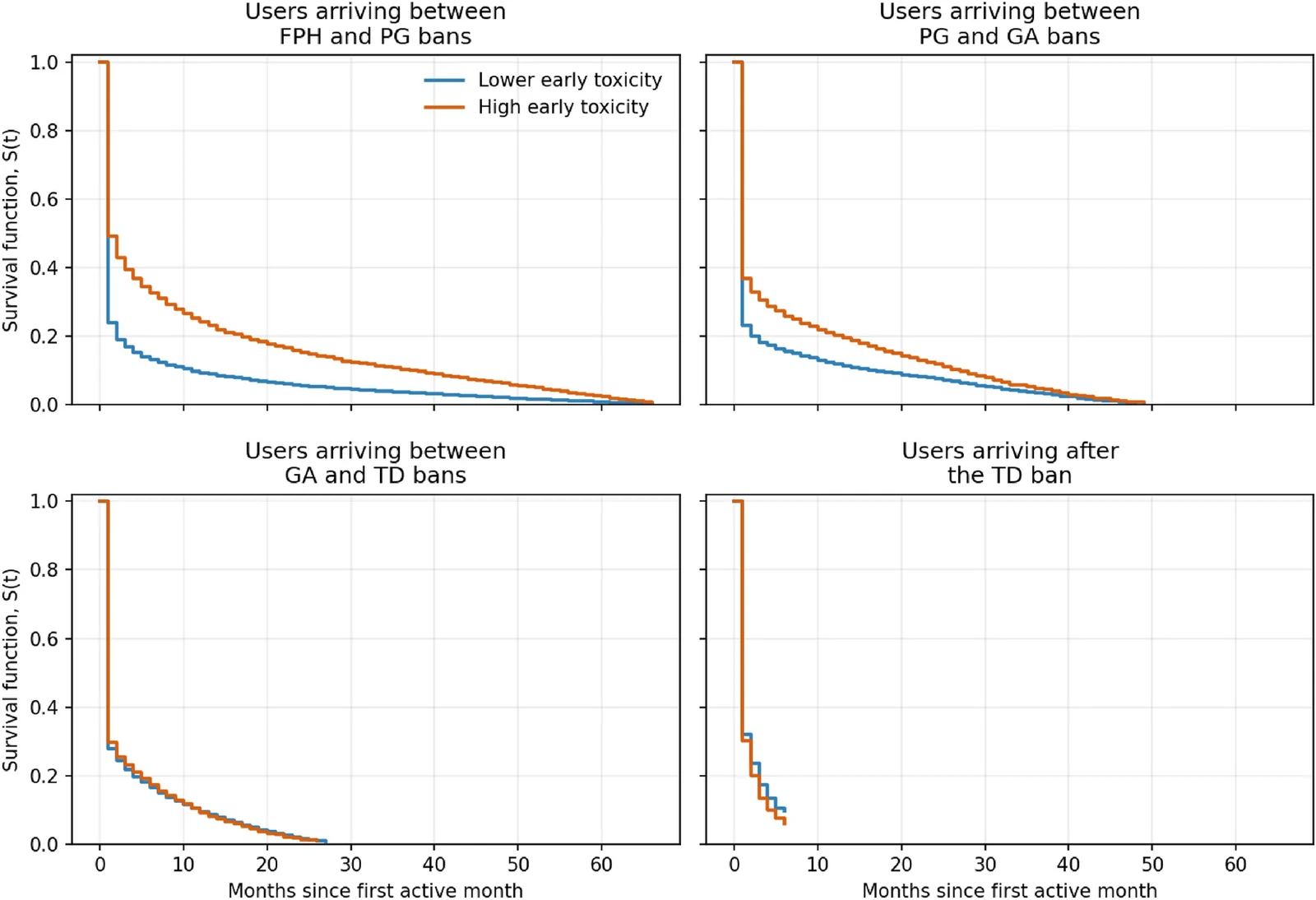
Among early arrivals, the more toxic ones stayed longer. For users who arrived between 2015 and 2018, the most toxic quarter in their first three months kept posting longer than other arrivals from the same period. Their monthly chance of leaving was 24% to 39% lower. For users who arrived after the 2018 ban, the difference mostly disappeared.
What it does not show
This is a descriptive study. We cannot say the bans caused these changes. Voat's loose rules, the kind of people it attracted and the platform simply getting older could produce similar trends. Our arrival groups are a proxy for migrants. After the first ban, new users arrived at more than ten times the usual rate. Around the later bans the usual rate was already much higher, so many of those arrivals would have come anyway. We only see replies to posts, not replies within comment threads. ToxiGen may miss Voat's own slang, and our human annotators agreed with each other only modestly on what counts as toxic.
Why it matters
A ban on one platform changes other platforms too, and the effects reach well beyond the dedicated hate spaces. On Voat, communities about jokes, games and pictures became more toxic over the years the bans happened, and drifted further from their Reddit twins. If we want to judge deplatforming as a tool, the receiving platforms and their ordinary users belong in the accounting.
Abstract
Deplatforming, the permanent banning of entire communities, is a common tool for content moderation on mainstream platforms. Prior research largely examines banned communities and source-platform health, leaving receiving platforms less understood. We analyze four major Reddit community bans from 2015 to 2020 and their relationship to six generalist communities on Voat, asking how users appearing on Voat after these bans are associated with community structure and toxicity. Combining network analysis, ToxiGen classifier probabilities, and dynamic reputation modeling, we document distinct trajectories in cohort mixing, structural representation, toxicity, and repeated participation across Voat’s generalist communities. Breakpoint analyses provide the clearest evidence around the GreatAwakening period in the E-I index, while mean ToxiGen classifier probability rose from approximately 0.12 in late 2015 to above 0.24 by mid-2018 and then remained elevated. Fixed-cohort results show that high-activity arrivals were more likely than average arrivals to become structurally central, and survival analyses indicate longer persistence among high early-toxicity users in earlier post-ban cohorts. These findings identify receiving-platform changes that coincided with source-platform moderation.
Cite
Tomašević, A., Vranić, A., Alorić, A., & Mitrović Dankulov, M. (2026). Reddit deplatforming and cohort mixing in generalist Voat communities. Scientific Reports. https://doi.org/10.1038/s41598-026-63627-4
@article{Toma_evi__2026, title={Reddit deplatforming and cohort mixing in generalist Voat communities}, ISSN={2045-2322}, url={http://dx.doi.org/10.1038/s41598-026-63627-4}, DOI={10.1038/s41598-026-63627-4}, journal={Scientific Reports}, publisher={Springer Science and Business Media LLC}, author={Tomašević, Aleksandar and Vranić, Ana and Alorić, Aleksandra and Dankulov, Marija Mitrović}, year={2026}, month=July }
Related
- Multi-Platform Aggregated Dataset of Online Communities (MADOC) (Proceedings of the International AAAI Conference on Web and Social Media, 2025)
- Sustainability of Stack Exchange Q&A communities: The role of trust (EPJ Data Science, 2023)
- All publications