Dataset paper · ICWSM 2025
Multi-Platform Aggregated Dataset of Online Communities (MADOC)
1 Institute of Physics Belgrade, University of Belgrade · 2 Faculty of Philosophy, University of Novi Sad · 3 Vinča Institute of Nuclear Sciences, University of Belgrade
In short: We put data from Reddit, Voat, Bluesky and Koo into one shared format: 18.9 million posts and 236 million comments from 23.1 million users. Every post and comment comes with sentiment and toxicity scores. The core is twelve Reddit communities, four of them later banned, matched with their counterparts on Voat.
Why a multi-platform dataset?
Online communities do not live on one platform. When Reddit bans a community, its members move somewhere else. When a new network opens, people bring their habits with them. Studying this means comparing platforms, and that is hard. Each platform stores its data differently, and API access keeps getting more restricted. We built MADOC so that researchers can start from one clean, shared format instead of four incompatible ones.
What is in it
MADOC combines existing public archives of four platforms: Reddit (from Pushshift), Voat, Bluesky and Koo, an Indian microblogging platform. We kept English-language content only.
- 4platforms
- 18.9Mposts
- 236Mcomments
- 23.1Munique users
For Reddit we chose twelve communities. Six are general-interest, such as r/funny, r/gaming and r/technology. Six are controversial. Four of those were banned: r/fatpeoplehate, r/GreatAwakening, r/MillionDollarExtreme and r/CringeAnarchy. Two were placed under heavier moderation: r/KotakuInAction and r/MensRights. For each one we took the matching community on Voat, the alternative platform where many banned users went.
Bluesky and Koo have no topic communities. We used topic models on the Reddit and Voat data to extract keywords for each community, then kept Bluesky and Koo posts that contain those keywords. A basic filter needs one keyword, and a strict filter needs two. With the basic filter we kept 910,376 posts and 932,545 comments from Bluesky, and 3,083,191 posts and 1,180,449 comments from Koo.
Every row is one post, comment or repost, with the same fields on every platform: pseudonymised post and user IDs, the ID of the parent post and its author, a timestamp, the text, extracted links, platform and community. We added two sentiment scores (VADER and TextBlob), a TextBlob subjectivity score and a ToxiGen toxicity score. On Reddit and Voat, we removed accounts where more than 70% of posts and comments contained the phrase “I am a bot”.
How to get it
The data are on Zenodo under a CC BY 4.0 licence, as Parquet files: one per community for Reddit and Voat, one each for Bluesky and Koo. Files share a schema, so they can be stacked together. The Python and R packages download single files or matched Reddit–Voat pairs. In Python:
pip install pymadoc

from pymadoc import download_file, download_community_pair

# Voat's r/gaming counterpart, straight into a DataFrame
voat = download_file("voat", community="gaming", as_dataframe=True)

# Reddit and Voat files for one community, saved to disk
reddit_file, voat_file = download_community_pair("gaming", output_dir="data")
Some Reddit files are several gigabytes, so it is better to save them to disk first. The R package rMADOC has the same main functions.
What the numbers show
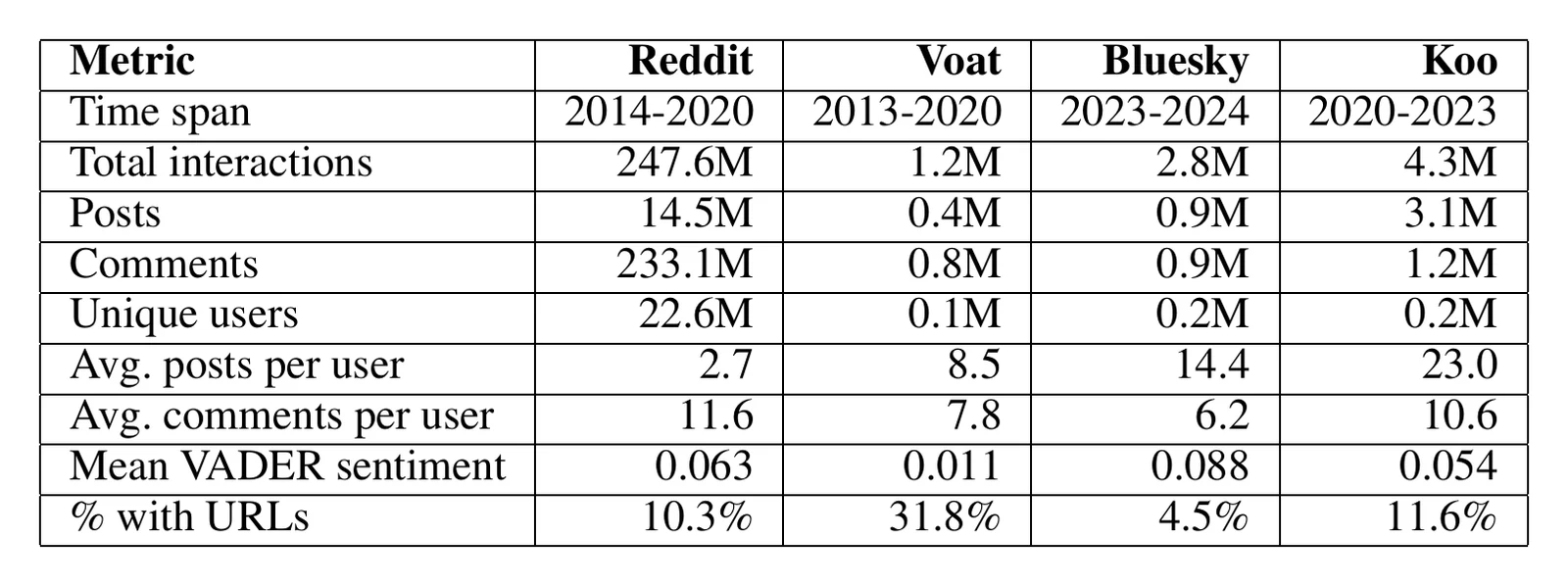
Reddit dominates in size, with 22.6 million users. Its communities are usually 100 to 1,000 times larger than their Voat counterparts: r/funny has 5.5 million users, v/funny has 20 thousand. Users on smaller platforms post more. Koo users average 23.0 posts each, Reddit users 2.7. Voat posts include links far more often (31.8%). Bluesky has the most positive average sentiment and Voat the least. General-interest communities lean positive on both Reddit and Voat. Controversial ones lean negative, with MensRights the most negative on both.
Limitations
The choice of general-interest communities was arbitrary, taken from active communities that existed on both Reddit and Voat. We did not cross-validate the keyword matching for Bluesky and Koo. Because the Voat archive lacks reply-to-reply links, MADOC keeps only first-level comments, so deep conversation threads are lost. The platforms cover different years, from 2013 to 2020 for Voat and 2023 to 2024 for Bluesky. Archives may miss content that was deleted before collection, and r/fatpeoplehate has no posts at all, only comments. We did not link users across platforms, for privacy reasons, so individual migration cannot be traced.
Who it is for
MADOC is for researchers who study moderation, deplatforming, toxicity and community dynamics, and who want to compare platforms without building the pipeline themselves. It is also a test bed for toxicity detection and other language tools. The data contain offensive content, which is the point for this kind of research, and we ask users not to try to re-identify anyone.
Abstract
The Multi-platform Aggregated Dataset of Online Communities (MADOC) is a comprehensive dataset that facilitates computational social science research by providing a unified, standardized dataset for cross-platform analysis of online social dynamics. MADOC aggregates and standardizes data from four distinct platforms: Bluesky, Koo, Reddit, and Voat, spanning from 2012 to 2024. The dataset includes 18.9 million posts, 236 million comments, and data from 23.1 million unique users across all platforms, with a particular focus on understanding community dynamics, user migration patterns, and the evolution of toxic behavior across platforms. By providing standardized data structures and FAIR-compliant access through Zenodo and corresponding Python and R packages, MADOC enables researchers to conduct comparative analyses of user behavior, interaction networks, and content sentiment across diverse social media environments. The unique value of the dataset lies in its cross-platform scope, standardized structure, and rich metadata, making it particularly suitable for studying societal phenomena such as community formation, toxic behavior propagation, and user migration patterns in response to platform moderation policies.
Cite
Dankulov, M. M., Tomašević, A., Maletić, S., Anđelković, M., Vranić, A., Cvetković, D., Stupovski, B., Vudragović, D., Major, S., & Bogojević, A. (2025). Multi-Platform Aggregated Dataset of Online Communities (MADOC). Proceedings of the International AAAI Conference on Web and Social Media, 19(1), 2529–2538. https://doi.org/10.1609/icwsm.v19i1.35954
@article{Mitrovi_Dankulov_2025, title={Multi-Platform Aggregated Dataset of Online Communities (MADOC)}, volume={19}, ISSN={2162-3449}, url={http://dx.doi.org/10.1609/icwsm.v19i1.35954}, DOI={10.1609/icwsm.v19i1.35954}, journal={Proceedings of the International AAAI Conference on Web and Social Media}, publisher={Association for the Advancement of Artificial Intelligence (AAAI)}, author={Mitrović Dankulov, Marija and Tomašević, Aleksandar and Maletić, Slobodan and Anđelković, Miroslav and Vranić, Ana and Cvetković, Darja and Stupovski, Boris and Vudragović, Dušan and Major, Sara and Bogojević, Aleksandar}, year={2025}, month=June, pages={2529–2538} }
Related
- Reddit deplatforming and cohort mixing in generalist Voat communities (Scientific Reports, 2026)
- Sustainability of Stack Exchange Q&A communities: The role of trust (EPJ Data Science, 2023)
- All publications